 subverge
Flow
Conditionals and loops are ordinary words that take quotes.
Choices
cond [ then ] [ else ] if
cond [ then ] when
cond [ then ] unless
Any non-zero condition is true. Nothing checks that both branches of an if leave the same number of values, so an unbalanced if shows up as a stack error later on.
Loops
n [ body ] times
a b [ body ] for                i from a to b-1, on the stack
[ test ] [ body ] while

0 3 [ . ] for                   prints 0 1 2
0 [ dup 3 < ] [ 1 + ] while     leaves 3
The while test must be a quote. Passing x 3 < instead of [ x 3 < ] evaluates the test once, so the loop either never runs or never ends.
Walking lists
list [ f ] each
list [ f ] map
list [ f ] filter
On a string, each gives character codes (strings).
Stopping
Ctrl-C interrupts any loop. The line fails with interrupted and is undone along with any partial result, unless the loop is inside try (catching).
Tracing
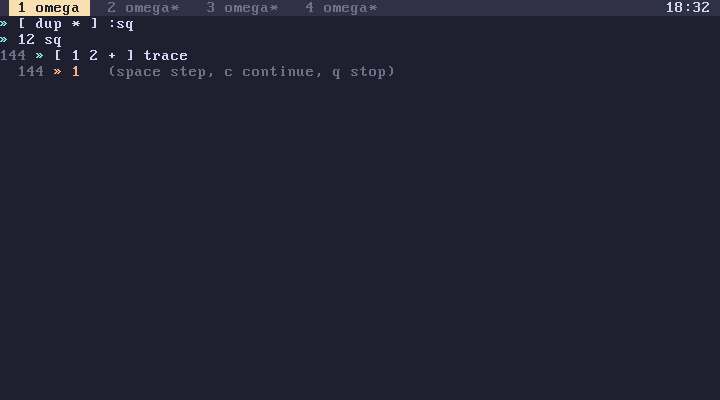
[ 1 2 + 4 * ] trace
trace runs a quote one word at a time and shows the stack after each. Space steps, c runs the rest and q stops. It is the nearest thing omega has to a debugger.
timeit, bench and watch time and repeat quotes (tools).
Recursion
[ { n } n 1 > [ n 1 - fib n 2 - fib + ] [ n ] if ] :fib
20 fib .                6765
Each level binds its own n, and only 256 locals can be live at once, so this fails around 256 levels deep with too many local names. Deep iteration should use a loop instead.
